
Bristol County City Directory Collections and Access
The strongest documented shelf is the State Library's Fall River inventory. It holds Bristol County city directories. Local libraries and museums add more volumes. Countywide titles, voting lists, maps, and local-history material supply separate dated layers. Check the repository first. A lead is just a lead until the volume itself is in hand.
| Collection | Years identified | Where held or described | Access route |
|---|---|---|---|
| Fall River city directories | 1866; 1869-74; 1876; 1878; 1880; 1882; 1884-85; 1887-1945; selected later runs through 1992 | Massachusetts State Library inventory, with Bristol County local archive leads | Confirm the shelf or digital item by year; pair a hit with other dated evidence. |
| Fall River and vicinity voting lists | 1978-80, 1986, 1988, 1990 | Massachusetts State Library collections | Historical snapshot only, not current registration proof. |
| Bristol County directory leads | 1867-68; 1870; 1872; 1875-76 | Established genealogy catalogs and collections | Exact local copy and image status remains unconfirmed. |
| Fall River Room and Community History Archive | Selected directories, maps, newspapers, and local records | Fall River Public Library | Local-history room and online archive availability vary by item. |
These Bristol County groups do not form one uninterrupted countywide sequence. Gaps happen for several reasons. A missing year can mean an unlocated volume. It can also mean a library gap or a different municipal collection. Note the miss and move on. Treat it as a narrow result rather than a conclusion about a household.
Bristol County City Directory Runs, Gaps, and Dates
Fall River owns the most specific published run in Bristol County: a few isolated nineteenth-century editions, a long sequence covering 1887 through 1945, and selected later volumes. Neighboring towns enter the picture through the Bristol County Directory & Gazetteer for 1867-68 and the Bristol County Directory & History leads for 1870, 1872, and 1875-76, which widen any street directory search beyond the city itself. Treat each title as a lead to confirm rather than a promise of a complete digital run, since availability differs volume by volume.
| Era | Documented Bristol County directory hook | How to use it |
|---|---|---|
| 1866-1885 | Early Fall River editions and county directory leads | Search a surname with initials and the municipality, then preserve the edition date. |
| 1887-1945 | Repeated Fall River city-directory editions in the State Library inventory | Build a year-by-year trail only from editions actually consulted. |
| 1954-1992 | Selected later Fall River volumes, with gaps between listed years | Use the nearest listed editions before and after a question date. |
Source note. One title captures one moment in Bristol County. It may list commercial, civic, or household entries. It proves no present address and no link between editions.
Bristol County City Directory Companion Sources
A Bristol County city directory works hardest beside a companion source. The State Library genealogy guide points researchers to city and town directories, voting lists, probate, and local-history collections across Massachusetts. Names repeat. A local-history desk can help, since its maps, photographs, newspapers, and catalog records often separate two people sharing a name. Label every piece with repository and edition date, and never blend several snapshots into one claim.
Sanborn fire-insurance maps test the physical setting of a directory address, and documented examples run deep in Fall River, with editions from 1888, 1893, and 1905 holding 30, 76, and 124 sheets respectively. New Bedford offers editions from 1888, 1893, and 1906. Fairhaven appears in the 1888 New Bedford set. The Library of Congress guide directs searches by state, city, county, date, and edition, then to the map key and sheet index. Read the key first. A map shows a footprint or a use at one date. It never names a person.
For a property question, add the deed book or plan reference from the correct registry district and label the evidence level. Each source plays one role. A directory is a historical snapshot. A Sanborn sheet is building context. An assessor layer is administrative, and a deed image is the recorded legal instrument. Keep those roles separate. The habit pays off when a Bristol County address changes form across decades.
Reading a Bristol County City Directory Entry
Treat each Bristol County city directory entry as an inventory of printed clues. Columns and abbreviations vary between runs. No single layout applies everywhere. Without that edition's own key, never assign a mark a meaning on guesswork. Capture the page. Note the publisher or edition year. Record the section too. Only then compare the directory entry against a map, deed, or census record.
| Name form | Surname, given name, initials, and any household or spouse notation printed on the line. |
|---|---|
| Occupation or business line | A trade, role, or business association where the edition includes one; preserve abbreviations exactly. |
| Street detail | House number, street, ward, or a separate business address when printed. |
| Household marks | Owner, boarder, widow, or other household notation only when the volume's key supports that reading. |
| Edition evidence | Page, section, abbreviation key, publisher or edition year, and any telephone line. |
- Criss-cross directory
- An address-first section that reverses the usual name-first order and associates an occupant or subscriber with an address in that edition.
- Householder index
- A name-oriented finding aid centered on the principal household listing when a volume provides one; verify the volume's scope before treating it as complete.
- Abbreviation key
- The explanatory key printed with a volume that defines its shortened labels; copy it before interpreting a household or street mark.
Bristol County City Directory Clues and RVRS Research
Vital clues need the right custodian. A Bristol County directory line pointing to a birth, marriage, or death should be routed there. It should not be treated as proof. The Registry of Vital Records and Statistics holds the principal state custody for 1936-present. Older material routes differently. A city or town clerk, the State Archives, or another historical collection may hold it. The event municipality and record type set the route. The RVRS genealogical-research guidance is a useful companion source. It serves a Bristol County city directory trail well.
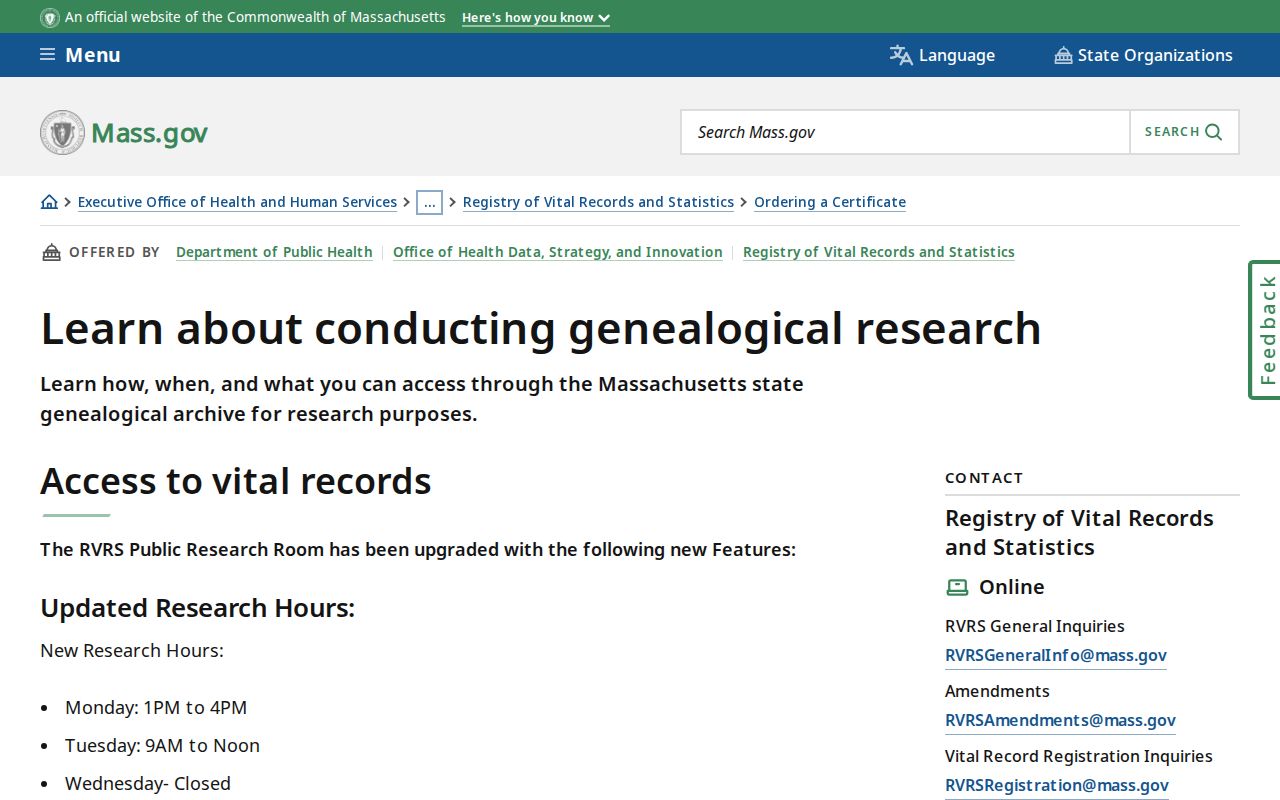
The guidance lists limited research-room hours. Digital indexes and PDF images for 1936-present are onsite-only, and certified-copy access runs as a separate route. A directory line is a locator, not a substitute request.
Bristol County City Directories and Taunton's Silver City Story
Taunton's official community profile adds a Bristol County story layer worth knowing. The city was incorporated as a town in 1639. It later became a city in 1864. Its "Silver City" identity grew from silversmithing. A dated city directory, a deed reference, and a map can together place a commercial address in that historical setting. This keeps broad local history from turning into a claim about an individual resident.
The same disciplined approach works across the county's distinct places. Fall River's textile-era built environment pairs naturally with the Fall River Room, historical maps, directories, and land records. New Bedford and nearby coastal communities carry their own port-facing archival context within Bristol County. Every note on a past resident or old address should keep the place, edition date, and source type visible.
Bristol County City Directory Desks at Old Colony and Fall River
The Old Colony History Museum in Taunton anchors directory research across southeastern Massachusetts. Its collecting strengths run to books, photographs, maps, letters, and documents. The particular focus is pre-1850 and Taunton. Visits happen by appointment. Listed hours are Tuesday through Saturday, 10:00 to 4:00. The museum offers hourly research at $50 an hour. Members pay $25. There is a one-hour minimum, so confirm the current fee before counting on it.
Down in Fall River, the public library is the other key desk. It answers a Bristol County residents directory question. Its Fall River Room holds archival records, books, genealogy material, and postcards. The Community History Archive adds selected directories, maps, and newspapers in digital form. Ask the desk whether the edition you need sits on site. It may exist digitally, or survive only as a catalog lead. The museum itself dates to 1853. It moved into the former Bristol Academy building in 1926. That pedigree makes it a documented local-history setting, not proof about any particular family.
Tracing a Household with Bristol County City Directories
A solid Bristol County city directory trail works across editions and then reaches outward to independent records. The goal is never to assemble a modern profile. It is to test whether names, addresses, and dates line up in sources created for different purposes, since agreement across unrelated records is what gives a household trail its weight.
- Choose a dated directory edition and search the surname with a street, ward, or initials where available.
- Transcribe every printed field, including number, spouse notation, occupation abbreviation, and any owner, renter, or boarder mark supported by the key.
- Check the nearest available edition before and after the first hit, noting a moved person, changed street number, or widow notation.
- Pair the directory years with the relevant federal census years and a deed or parcel reference; the most recent federal census is not immediately public under the 72-year rule.
- Use a map, newspaper, archive, or the applicable custodian to test the historical address, then retain the source date and any unresolved gap.
A disappearance can mean many things. It might reflect a move, a changed listing form, an omitted edition, or a death. The directory line alone cannot settle which one occurred. If the question turns to a living person or a contemporary official record, the separate Bristol County resident lookup guide lays out the correct verification route.
Bristol County City Directory Limits and Provenance
Directories, Sanborn maps, and historical voting lists remain dated evidence. A map may show a building footprint or use at an edition date. A directory can show an address association in its publication year. Neither proves modern occupancy, legal title, or a protected address. The Massachusetts Interactive Property Map and municipal assessor files are separate administrative layers entirely. A deed registry is the route for a recorded instrument.
Keep a compact provenance note for every find. Record the exact entry, edition year, page or section, repository, source URL, access date, and the next record to check. Bristol County operates three Registry of Deeds districts. So an address-based follow-up must first be routed by municipality. It goes to Northern Bristol/Taunton, Bristol Fall River, or Southern Bristol/New Bedford. That routing step prevents a historical blank from being mistaken for a countywide absence.