
Bristol County Previous Residents by Era
Previous residents leave different kinds of evidence in different periods. Begin with the Registry district chosen by municipality, then add the historical source closest to the year in question. A deed trail is often the most durable Bristol County property path. A historical directory can show an address association in one publication year, while a Sanborn map can show the building and street layout at an edition date. Each source needs its own date and custody note.
| Bristol County source | Years it covers | Where held | What it can show |
|---|---|---|---|
| Northern Bristol recorded-land index | 1735 to present, as printed by the Registry | Northern Bristol Registry, Taunton | Bristol County recorded parties, document type, date, town, and book/page or instrument reference |
| Southern Bristol old index books | Listed ranges beginning in 1690 | Southern Bristol Registry, New Bedford | Bristol County historical grantor/grantee index-book trail and alphabet sections |
| Fall River Registry index | Online emphasis from 1956 to present | Bristol Fall River Registry | Bristol County modern grantor/grantee lead; older Registry books need a separate route |
| Fall River city directories | Selected editions from 1866 through 1992 | State Library inventory and local archive leads | Bristol County dated household, address, or business snapshot |
| Sanborn maps | Bristol examples from the late nineteenth and early twentieth centuries | Library of Congress and local collections | Bristol County building footprint, use, street form, and map context at edition date |
For a recent Bristol County transfer, start at the Registry. For a property that appears before a web index span, move directly to old index books, a Registry counter, library collections, or an archive. A no-result screen is not a finding that the address had no past residents.
Bristol County Previous Residents Need a District
Bristol County has three land-record districts. Northern Bristol serves Attleboro, Berkley, Dighton, Easton, Mansfield, North Attleborough, Norton, Raynham, Rehoboth, Seekonk, and Taunton. Bristol Fall River serves Fall River, Freetown, Somerset, and Swansea. Southern Bristol serves Acushnet, Dartmouth, Fairhaven, New Bedford, and Westport. The municipality, not a loose county label or postal city, selects the first Registry search.
The difference matters most in a long Bristol County house history. Northern gives a printed recorded-land range from 1735 and a separate Land Court range from 1903. Southern’s digitized old-index series begins in 1690. Fall River has older records at the Registry even though its online grantor/grantee search emphasizes 1956 forward. These are useful numbers because they tell a researcher when to switch access channels.
Note: A postal place, MassGIS community, and legal town can differ, so retain the exact municipal field used for every Registry query.
Trace Bristol County Deeds Backward
A Bristol County chain of title is a sequence of recorded transfers, not a list copied from a parcel popup. Start with an assessor or MassGIS reference for the current parcel, then open the actual Registry index and image route. The current grantee on a purchase instrument identifies the buyer, while the grantor identifies the person or party transferring the interest. Walking from each buyer’s acquisition deed to the prior seller’s acquisition deed builds the backward path.
- Record the site address, legal municipality, parcel clue, book/page, registry ID, and map date for the Bristol County parcel from the assessor or MassGIS layer.
- Use the Bristol County district’s recorded-land or registered-land search to find the current owner or party and the acquisition instrument.
- Read the Bristol County image or order the appropriate copy. Capture the document type, recording date, book/page or instrument number, party roles, legal description, and any plan reference.
- Search the prior Bristol County transfer party as a grantee to locate the earlier acquisition. Repeat name variants, initials, former names, and entity or trust names when the record supports them.
- When the web search ends, take the saved book/page, document, or plan reference to the Bristol County Registry counter, direct office route, older index books, or archive.
- Grantor and grantee
- The grantor transfers an interest; the grantee receives it. Both roles are index search choices, not proof of present residence.
- Chain of title
- The sequence of Bristol County recorded transfers checked through the underlying instruments rather than owner labels alone.
- Legal description
- The property description in an instrument or plan. It can outlast a street rename or number change.
Northern Bristol Previous Residents Trail
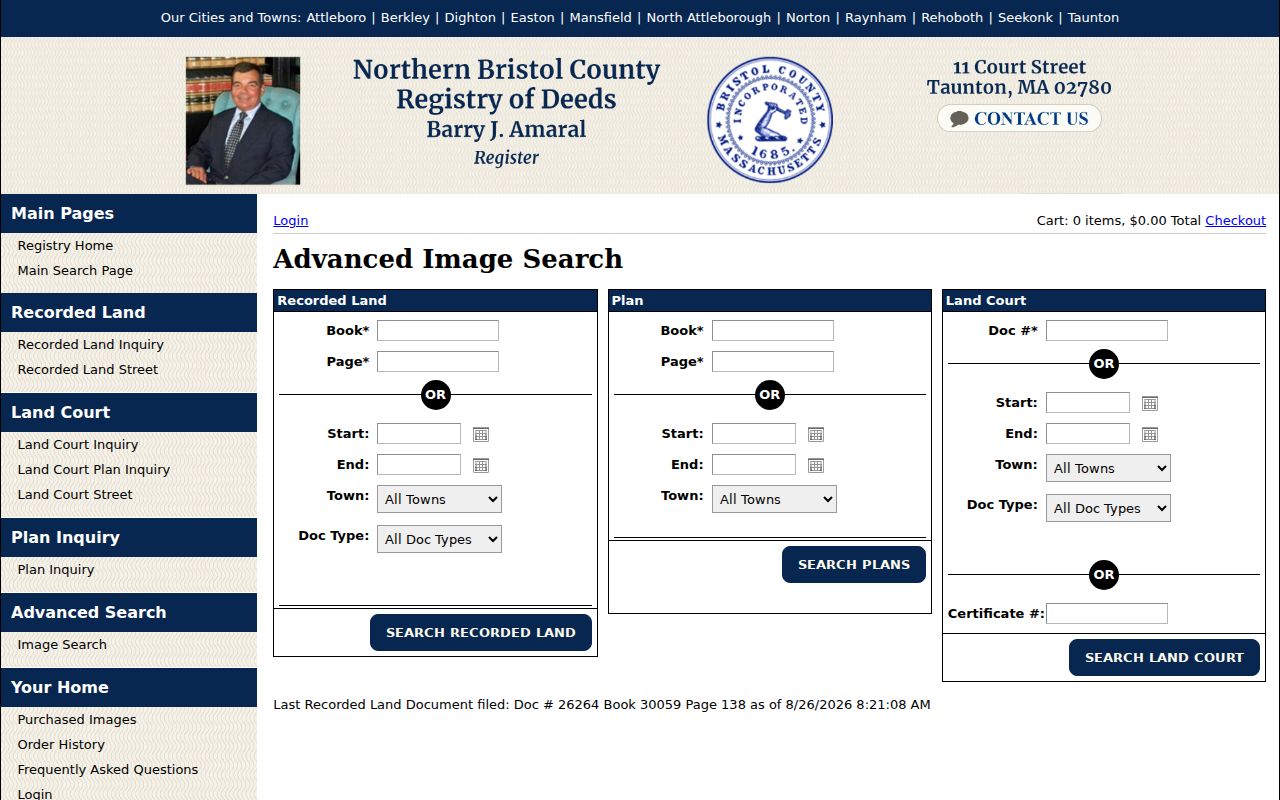
Northern Bristol’s Advanced Image Search is useful after a prior Bristol County deed, plan, or assessor card supplies a reference. It can search recorded land by book and page or by a date range, town, and document type. The Land Court route offers document-number and certificate-number paths. Image access and purchasing are separate actions, and a certified or official copy comes from the Registry.
The official Northern advanced-image source shows the book/page, date, town, document, and certificate options.
A Bristol County book/page is a strong provenance note, but it does not replace reading the instrument. Separate recorded land from registered land, preserve the document category, and do not turn a recent indexed party into a claim about who lived at the site.
Southern Bristol Previous Residents Indices
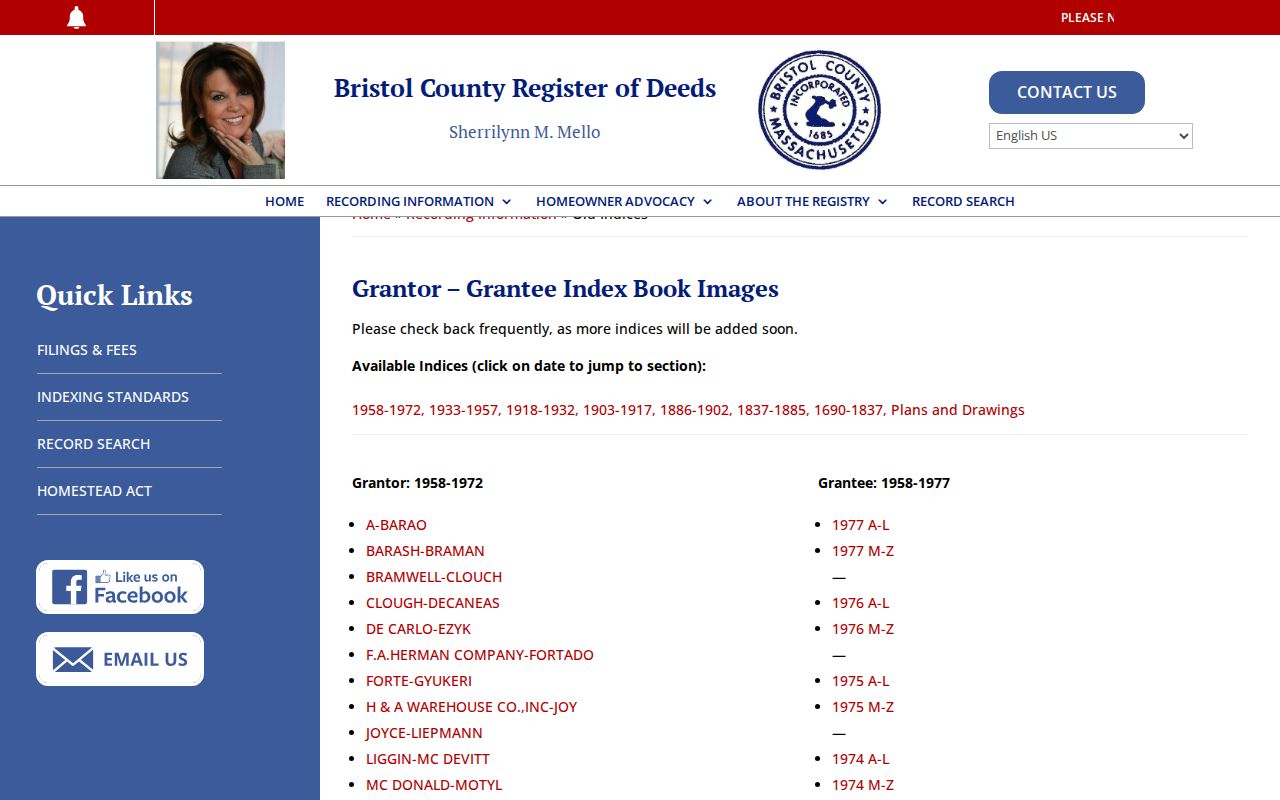
Southern Bristol’s digitized old indices are central for Acushnet, Dartmouth, Fairhaven, New Bedford, and Westport address history. The listed index-book ranges are 1690-1837, 1837-1885, 1886-1902, 1903-1917, 1918-1932, 1933-1957, and 1958-1972, with alphabet sections. The Registry separately identifies non-indexed books and documents, so a gap in the index books may need a different research route.
The Southern old-index source provides the historical ranges needed for a Bristol County previous residents search.
Southern’s current search page directs users to a newer system for Bristol County records and indicates that image orders require an account and credit card. For a certified or official copy, use the direct Registry route. Keep surname-spacing variants in the search log, since the Registry specifically flags forms such as De Mello and DeMello.
Bristol County Past Address Changes
Bristol County past residents can be hidden by an address change rather than a missing record. Street numbers may be reused after demolition or subdivision. A street can be renamed, and a postal place may not be the legal town stored in a Registry form. Compare the legal description, lot or plan reference, nearby cross streets, and map edition when the same number appears in different decades. Treat a mismatch as a question to test, not a typo to silently correct.
MassGIS provides map context and parcel attributes, while a Sanborn sheet can show street geometry and building use at a historical date. The Library of Congress advises searching Sanborn material by state, city, county, date, and edition, then reading the map index and sheet notes. A historic map supplies dated context; it does not identify a household on its own.
Bristol County Previous Residents in Directories
The deed chain follows recorded interests, while household sources answer who was listed at an address in a particular year. The Massachusetts State Library inventory includes many Fall River city-directory editions, beginning with 1866 and continuing through repeated nineteenth- and twentieth-century runs, with selected later editions through 1992. Fall River Public Library local-history materials include directories, maps, newspapers, genealogy resources, and a Community History Archive. An entry can represent a business, boarder, household member, or prior occupant, so label it as a dated entry.
The collections themselves are best located through the Bristol County city directory. For a backward Bristol County address trail, copy the printed street form, number, surname, initials, household notation, and edition year exactly, then compare the surrounding editions. Do not use a historical line as a current address confirmation.
Pair Bristol County Past Residents by Date
Pairing directory years with federal census years helps distinguish a one-year address association from a household trail. The latest federal census is not immediately public under the 72-year release rule, so confirm the available release at the Census Bureau before relying on a year. Census, directory, deed, map, newspaper, and probate materials each describe a different relationship to the address.
- Choose a directory edition close to the period in question and transcribe the name, street number, initials, and any printed household notation.
- Check the nearest available edition before and after it for a move, altered number, widow notation, or a changed address form.
- Pair that period with the available census schedule and preserve the enumeration date rather than treating it as an ongoing record.
- Compare the address with a deed, parcel, Sanborn sheet, newspaper, or probate reference, then note whether the evidence is legal, administrative, or historical.
Taunton’s Old Colony History Museum offers another historic layer, with Southeastern Massachusetts and pre-1850 holdings. Research visits are by appointment, and the museum lists research-for-hire terms that should be confirmed before ordering assistance. Its 1853 founding is a useful local-history marker, not a fact about a particular address.
Limits on Bristol County Previous Residents
Previous residents research is strongest as house history, family history, and property context. It should never be used to build a profile of a living person. A deed party may not have lived at the property. An assessor owner field can be a tax or mailing association. A dated directory or census entry can establish only what that source reported on its date. Public records also contain redactions, age limits, and protected address rules.
Massachusetts ACP participants may use substitute addresses, and the absence of a result is not proof of non-residence. A narrow request under M.G.L. c.66 and 950 CMR 32.00 et seq. can seek an existing non-exempt municipal record, while court, vital, voter, and sealed material follow separate access rules. Ask the original custodian to correct an error or explain a redaction. For an unresolved record mismatch, compare the exact name, town, date, role, document type, and source date before adding another source. Preserve the search input and access date so a later researcher can understand the result.